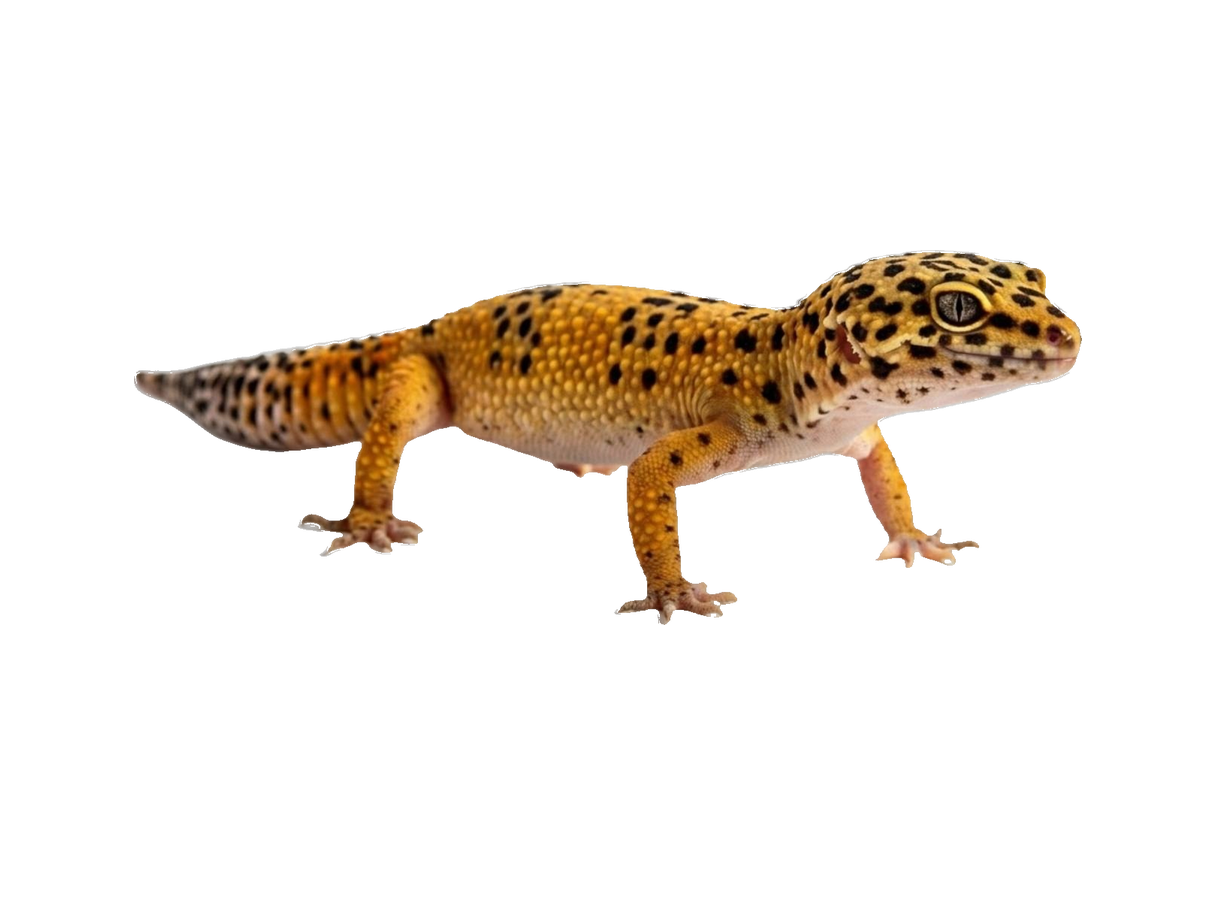
01 / Quick care
Dry ambient air, secure hides, measured heat
A leopard gecko needs a terrestrial enclosure with a clear warm-to-cool gradient, multiple hides including a moist hide, relatively dry ambient air, appropriately sized live prey, and routine observation. Labels on heaters and lamps do not prove those conditions exist.
02 / Before you buy
Long lifespan, not a low-effort shortcut
RVC materials note that leopard geckos can live up to about 20 years. Plan for a decade-scale commitment: enclosure floor space, electricity, feeder insects, lamp replacement, moist-hide maintenance, and access to a reptile-experienced veterinarian.
ARAV client education recommends a wellness exam and fecal parasite check for new animals, plus quarantine away from other reptiles. Finish and test the enclosure before the animal arrives.
ReptBase does not describe leopard geckos as universally “perfect for beginners.” Difficulty depends on the keeper’s ability to measure conditions, maintain hygiene and seek veterinary care.
03 / Enclosure
Floor area for a gradient and choices
Sources describe different absolute minimums. ReptBase therefore emphasizes usable floor length for a warm-to-cool gradient, secure ventilation and at least three retreat options rather than a single marketed “starter kit” size.
04 / Heating
Targets are measured zones, not wattage
RVC and ARAV materials describe a warm basking or warm-end zone and a cooler retreat. Treat published figures as zones to verify with probes. Enclosure size, material, room climate and mounting distance change heat loss.
- Log the room.Record day and night temperatures where the enclosure will live.
- Describe the enclosure.Dimensions, substrate depth, ventilation and hide mass all change heat retention.
- Plan source and probe placement.Avoid unprotected contact burns; secure the thermostat probe where it represents the animal’s choices.
- Test overnight cycles.Confirm the warm retreat, cool retreat and any overnight floor before bringing an animal home.
05 / Lighting and UVB
Provide a day–night cycle; verify low-level UVB
Leopard geckos are crepuscular. Welfare and veterinary sheets still recommend a photoperiod and low-percentage UVB with shade, and Gould et al. (2018) showed juvenile leopard geckos can raise plasma 25-hydroxyvitamin D3 under compact fluorescent UVB in study conditions.
- Group light with the warm end so the cool end remains darker and lower UV.
- Follow manufacturer distance guidance; mesh and height change output.
- Meter UVI at animal height and replace lamps on schedule.
- Seek veterinary advice for light-sensitive morphs rather than copying a generic bright setup.
06 / Humidity and moist hide
Dry ambient air is not the same as a dry hide
RSPCA guidance targets cool-end ambient humidity commonly around 30–40% RH. Separately, a moist hide with damp moss or similar media provides local humidity for shedding. Running the whole vivarium wet to “help shedding” is not what those sheets describe.
Refresh and clean moist-hide media regularly. If ambient humidity stays high, increase ventilation and reassess for skin or respiratory risk with a veterinarian when signs appear.
07 / Substrate
Choose for monitoring and ingestion risk
| Approach | Useful when | Tradeoff |
|---|---|---|
| Paper or towel | Quarantine, stool monitoring, rapid replacement | Low enrichment; replace promptly when soiled |
| Solid tile or carpet marketed for reptiles | Easy cleaning with secure footing | Must stay clean; avoid frayed fibers that catch toes |
| Loose sand or fine particulate | Generally discouraged in ARAV client education for typical pet setups | Impaction and cleaning difficulty risks when misused |
08 / Feeding
Appropriately sized live prey, not guesswork
Leopard geckos are insectivores. Offer varied, appropriately sized feeders, remove uneaten prey that could injure the gecko, and track body condition. Gut-loading and feeder quality matter; they are not a substitute for veterinary nutrition advice when an animal is underweight, obese or refusing food.
09 / Supplements
Plan calcium with the whole UVB and diet system
ARAV and general reptile husbandry references discuss calcium and vitamin D as part of preventing metabolic bone disease, but they do not authorize one universal dusting calendar for every age, morph, diet and UVB setup.
List feeder species, gut-loading and any fortified products.
Meter output, distance, shade and lamp age.
Select calcium and D3 strategy for this animal.
Avoid overlapping products that double-dose D3.
10 / Handling and behavior
Security first; no universal cohabitation claim
Support the body, keep early sessions short, and watch for repeated escape attempts or defensive behavior. Never restrain by the tail. Crepuscular animals may be more active at dusk; do not interpret daytime stillness alone as illness without other signs.
ARAV notes limited cohousing constraints such as avoiding multiple adult males. That is not a recommendation to house leopard geckos together by default. ReptBase recommends one animal per enclosure unless a veterinarian and a reviewed plan say otherwise.
11 / Cleaning
Clean by contamination, refresh the moist hide
Remove waste and uneaten prey promptly, refresh water, and replace moist-hide media before it becomes fouled. For a full clean, relocate the gecko safely, remove organic matter, use a reptile-appropriate disinfectant as labelled, rinse when required and dry fully before reassembly.
12 / Shedding
A maintained moist hide is the primary shed aid
Healthy sheds should complete without stuck bands on toes, eye caps or the tail tip. Check digits after each shed. Chronic retained shed is a husbandry and veterinary problem, not a reason to soak the entire vivarium.
13 / Health warning signs
Respond to change; do not diagnose from a webpage
Contact a reptile-experienced veterinarian promptly
- Breathing difficulty or open-mouth breathing at rest
- Collapse, seizure, severe weakness or inability to right
- Major injury, bleeding or suspected toxin exposure
- Constricted toes from retained shed with swelling or necrosis risk
Persistent changes deserve investigation
- Ongoing appetite or weight change
- Soft jaw, tremors or altered gait
- Repeated abnormal stools or parasites concerns
- Eye, mouth or chronic shed problems
ReptBase cannot diagnose an animal. Husbandry correction may support veterinary care; it is not a substitute for it.
14 / Setup cost status
No unsourced price ranges on this page
15 / Climate adaptation
Outdoor normals change workload, not species targets
Using Albuquerque as a worked outdoor example, NOAA normals report an annual daily maximum of 70.3°F, annual daily minimum of 45.5°F and annual mean of 57.9°F.
January average daily low outdoors. Check whether the room holds a safe overnight floor for the cool retreat.
July average daily high outdoors. Watch for room overheating that collapses the cool end.
HVAC, windows and insulation determine the enclosure response.
Leopard gecko care targets remain species-specific. Do not copy Bearded Dragon temperature or UVB bands into this setup.
16 / Sources and editorial status
What supports this guide
- 01
Leopard Gecko Care Sheet
RSPCA · 2019
Welfare-oriented husbandry starting points for enclosure size and security, measured cool-end humidity around 30–40% RH, moist hide use, thermal gradient planning, low-percentage UVB with meter verification, and health observation themes. Limitations: UK welfare care sheet; not a clinical protocol. UVB percentage and distance still require manufacturer guidance and metering. Does not authorize fixed wattage or fixed supplement schedules. - 02
Leopard Gecko Care
Royal Veterinary College (RVC)
Natural range context (parts of Iran, Afghanistan, Pakistan, northwest India), longevity up to about 20 years, need for a thermal gradient with measured basking and cool ends, hides including a moist hide, and veterinary framing that low-percentage UVB appears beneficial. Limitations: Institutional care sheet without a dated revision stamp in the PDF filename. Temperature figures must be treated as measured targets, not heater settings. Does not support Australian habitat claims. - 03
Leopard Gecko
Association of Reptilian and Amphibian Veterinarians (ARAV)
Veterinary client education on quarantine and fecal checks, thermal gradient bands commonly cited for captive setups, multiple hides plus a humid hide, preference for easy-clean substrates over loose sand, and the statement that studies support regular low-level UVB even for this crepuscular species. Limitations: Brief client trifold; not a full systematic review. Cohousing language is limited and conditional (for example, avoid multiple adult males). Does not define a universal calcium/D3 dusting calendar for every animal. - 04
Management and Husbandry of Reptiles
MSD Veterinary Manual
General reptile husbandry principles: ectothermy and measured gradients, thermostatic control of heat sources, provision of appropriate UVB where indicated, hygiene, and that nutritional disease prevention depends on the whole system rather than a single product claim. Limitations: Genus-agnostic manual chapter. Must not be used to invent leopard-gecko-specific wattage, enclosure dimensions, or morph-specific lighting without species sources. - 05
Ultraviolet B Radiation Emitted by Compact Fluorescent Lamps Increases Plasma 25-Hydroxyvitamin D3 in Juvenile Leopard Geckos (Eublepharis macularius)
Journal of Herpetological Medicine and Surgery · 2018
Peer-reviewed evidence that juvenile leopard geckos exposed to UVB from compact fluorescent lamps can increase plasma 25-hydroxyvitamin D3 relative to unexposed animals under the study conditions. Limitations: Experimental husbandry context; does not by itself prescribe a commercial fixture, distance, photoperiod, or adult protocol. Does not eliminate the role of diet and veterinary assessment.