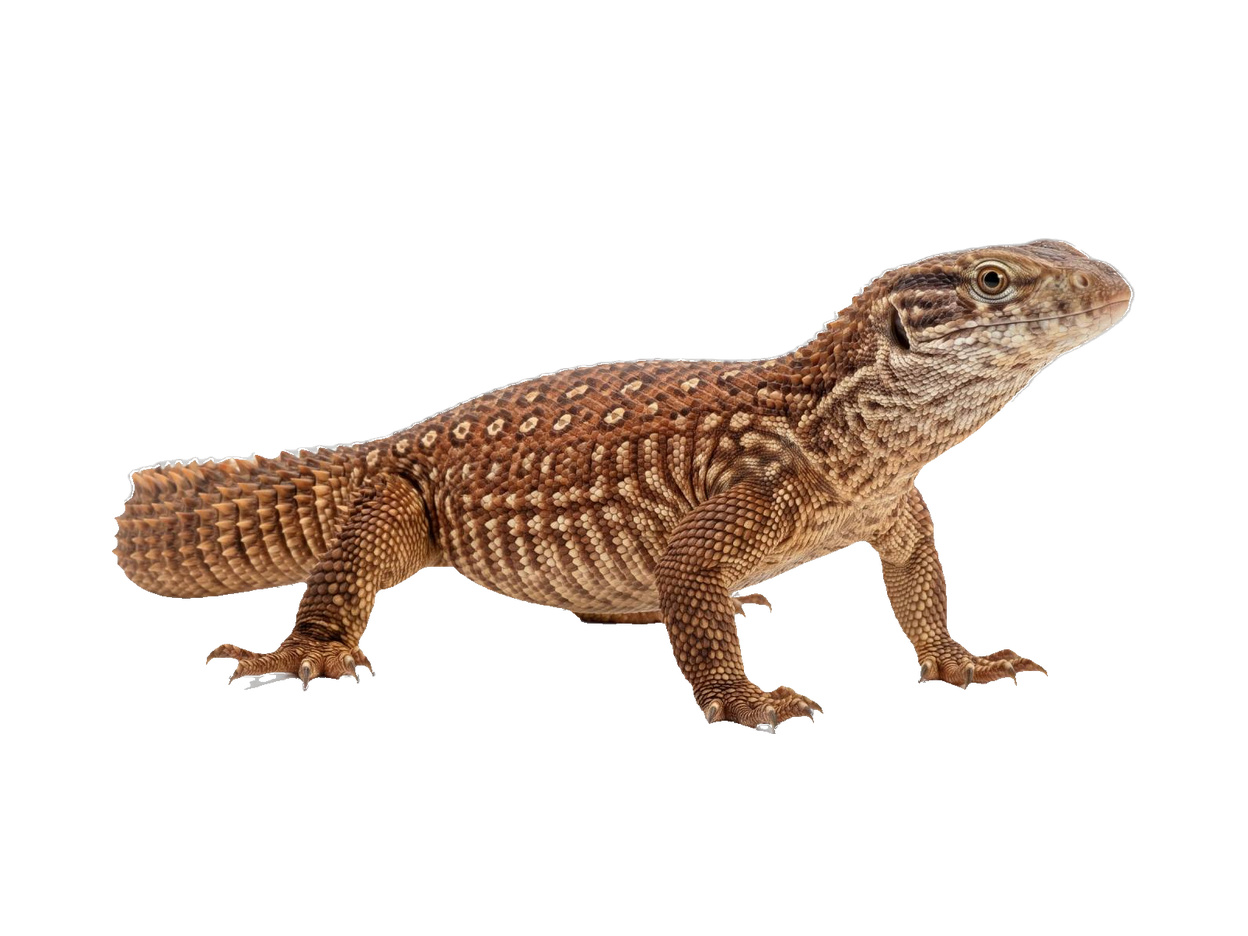
01 / Quick care
Deep substrate, measured heat, a burrowing desert monitor
An ackie monitor needs a large terrestrial enclosure with deep loose substrate for burrowing, a very high measured basking surface, a dry ambient band, appropriately sized live insect prey, and enough retreats and stacked bark for a naturally active animal. Heat and UVB labels do not prove those conditions exist; only probes and meters do.
02 / Size and lifespan
A small monitor, still a decade-scale commitment
The imported ReptBase record lists a maximum adult length around 70 cm and a lifespan often up to about 15 years. Treat both as planning context, not a care recommendation, for a real animal: body size depends on lineage, diet, enclosure and veterinary care, and captive records differ.
AFD ecology describes Varanus acanthurus as an Australian endemic of arid and seasonally dry rocky country in Western Australia, the Northern Territory and Queensland. The "small monitor" framing is accurate for the genus, but it is not permission for a small enclosure: burrowing, heat zones and exercise floor all still matter.
Size queries are answered by planning, not by a single number: adult length affects enclosure floor, burrow depth and prey size, and every one of those should be designed before the animal arrives.
03 / Before you buy
Active, intelligent and not a low-effort shortcut
Ackie monitors are described in the imported record as very active and intelligent animals that dig and explore. That is a demanding combination: they need large floor space, deep substrate, stacked bark retreats, live insects, high-basking heat and routine observation.
MSD veterinary guidance frames husbandry planning as something done before the animal arrives: enclosure size tied to adult size and natural behaviour, substrate, hiding and security needs. Finish and test the full setup, including overnight heat cycles and burrow stability, before introducing an animal.
ReptBase does not call ackie monitors "easy" or universally "for beginners." Difficulty depends on the keeper's ability to maintain deep substrate, measure very high basking heat and manage a long-lived, intelligent insectivore.
04 / Enclosure and tank size
Floor area for a gradient, burrowing and choices
The imported record lists an enclosure around 150 × 60 × 60 cm. ReptBase treats that as a starting reference, not a marketing standard: the real requirement is usable floor length for a warm-to-cool gradient, secure depth for burrowing and stacked bark, and room for an active monitor to move. Absolute marketed "kit" sizes are not a substitute for measured conditions.
- 01Warm end
Textured basking slab under the heat lamp, measured with a surface probe where the animal stands.
- 02Burrow zone
Deep substrate the monitor can fully disappear into.
- 03Retes stacks
Layered bark holding warm and cool pockets.
- 04Cool retreat
A shaded end where the monitor can leave the warm zone while staying secure.
- 05Water dish
Fresh water refreshed daily.
- 06Ventilation
Secure vents with no escape gaps.
05 / Heating and basking temperature
Very high basking surfaces are measured zones, not wattage
The imported record lists very high basking temperatures around 120–150°F with a cooler ambient band and a night floor near 72°F. Treat published figures as zones to verify with surface probes at animal height. Enclosure size, material, room climate and mounting distance all change heat loss.
- 01Heat lamp
Over the warm end, thermostatically controlled.
- 02Basking surface probe
Published zone 120–150°F, verified at animal height on the slab.
- 03UVB tube
Overlapping the basking zone; meter UVI at animal height.
- 04Warm-zone ambient probe
Confirms the ambient band is not overtaken by basking heat.
- 05Full-shade cool retreat
Lower UV and light so the monitor can leave the warm zone.
- Verify, do not assume
Published figures are zones to verify with probes and a UV meter, never wattage or fixture labels.
- Log the room.Record day and night temperatures where the enclosure will live.
- Describe the enclosure.Dimensions, substrate depth, ventilation and stacked bark all change heat retention and burrow warmth.
- Plan source and probe placement.Avoid unprotected contact burns; secure the thermostat probe where it represents the animal's choices.
- Test overnight cycles.Confirm the basking surface, warm zone, cool retreat and any overnight floor before bringing an animal home.
06 / Lighting and UVB
Diurnal desert activity means plan UVB; do not assume it away
AFD ecology lists Varanus acanthurus as diurnal and desert. The imported record flags UVB as not required, but that field is imported dataset context, not a medical recommendation for a diurnal monitor. ReptBase recommends planning a measured UVB gradient and treating the imported "false" as data to question, not a free pass.
- Group light with the warm end so the cool retreat and burrows remain shaded and lower UV.
- Follow manufacturer distance guidance; mesh and height change output.
- Meter UVI at animal height and replace lamps on schedule, as the UV-Tool methodology describes.
- Seek veterinary advice rather than copying a generic bright setup for another lizard species.
07 / Substrate and burrowing
Depth is a behaviour need, not a decoration
- 01Dry surface band
Stays loose when dry, in line with the dry ambient target.
- 02Deep compacted layer
About 12 inches deep; holds a burrow when compacted.
- 03Burrow network
Stable tunnel and chamber shapes the animal maintains.
- 04Retes stack
Layered bark on the surface, holding warm and cool pockets.
- 05Supported basking structure
Stable and not able to collapse the burrow below.
- Monitor stability
Reassess depth and moisture if burrows keep collapsing; the dashed example shows an unstable tunnel.
The imported record calls for deep substrate (about 12 inches) for burrowing and recommends retes stacks: layered wood that holds warm and cool pockets. A bare floor cannot meet this species' digging behaviour, and shallow substrate collapses the burrow system this animal is built to maintain.
Choose a substrate that stays loose when dry, holds a burrow when compacted, and can be spot-cleaned without a full teardown. Keep a dry surface band in line with the dry ambient target, and avoid mixing in wet media that contradicts the desert record. If burrows are repeatedly collapsing, reassess depth and moisture before adding the animal.
08 / Feeding and diet
Insectivore first; rodents are a rare treat at best
| Feeder type | Role | Notes |
|---|---|---|
| Staple insects | Main diet | Dubia roaches, crickets, grasshoppers, silkworms |
| Prey size | Size to the animal | Appropriately sized live prey; remove uneaten prey |
| Rodents | Very rare treat at best | Imported record warns against obesity |
| Calcium plan | With UVB and a vet | No universal dusting calendar |
The imported record lists a strictly insectivorous natural diet with staple prey such as dubia roaches, crickets, grasshoppers and silkworms, and warns that rodents should be a very rare treat to avoid obesity. Offer varied, appropriately sized live insects, remove uneaten prey, and track body condition.
Feeding frequency in the record is daily for juveniles and every other day for adults, which is a starting rhythm, not a universal calendar. Monitor appetite and weight, and consult a veterinarian for any animal that is underweight, obese or refusing food. For the broader insect-feeding and prey-sizing workflow, see the reptile feeding guide.
09 / Supplements
Plan calcium with the whole UVB, diet and monitoring system
The imported record lists calcium with D3 every other feeding and a weekly multivitamin. General veterinary references discuss calcium and vitamin D as part of preventing metabolic bone disease, but they do not authorize one universal dusting calendar for every animal, diet, UVB setup and age.
List feeder species, gut-loading and any fortified products.
Meter output, distance, shade and lamp age for this diurnal animal.
Select calcium and D3 strategy for this animal, not a generic copy.
Avoid overlapping products that double-dose D3.
10 / Handling and behavior
Respect an intelligent, fast, burrowing animal
Ackie monitors are described as curious and very active. Early handling sessions should be short, calm and close to a soft surface, and you should watch for repeated escape attempts, tail whipping or refusal to feed as stress signs. Never grab by the tail.
The imported record lists pairs or trios as possible in a large enclosure with monitoring for bullying. That is imported dataset context, not a blanket recommendation: ReptBase recommends one animal per enclosure unless a veterinarian and a reviewed plan support cohousing.
Because the species is intelligent and fast, enclosure security matters: gaps, loose lids and climbable wiring are escape routes, not enrichment.
11 / Cleaning
Spot-clean the burrow system without collapsing it
Remove waste and uneaten prey promptly and refresh water daily. With deep substrate, spot-clean contaminated areas rather than stripping the whole burrow system weekly, and schedule a periodic full refresh with a reptile-appropriate disinfectant as labelled, rinsing and drying fully before reassembly.
Watch for fouling deep in burrows: a burrowing animal can hide soiled areas that surface spot-cleaning misses. If odour persists or the substrate stays damp, reassess depth, drainage and ventilation.
12 / Health warning signs
Respond to change; do not diagnose from a webpage
Contact a reptile-experienced veterinarian promptly
- Breathing difficulty or open-mouth breathing at rest
- Collapse, seizure, severe weakness or inability to right
- Major injury, bleeding or suspected toxin exposure
- Constricted digits or tail tip with swelling or necrosis risk
Persistent changes deserve investigation
- Ongoing appetite or weight change
- Soft jaw, tremors or altered gait (possible metabolic bone disease concerns)
- Repeated abnormal stools or parasite concerns
- Stuck shed on the tail or chronic shedding problems
ReptBase cannot diagnose an animal. Husbandry correction may support veterinary care; it is not a substitute for it. MSD emergency guidance frames urgent reptile signs for prompt veterinary attention.
13 / Setup cost status
No unsourced price ranges on this page
14 / Climate adaptation
Outdoor normals change workload, not species targets
Using Albuquerque as a worked outdoor example, NOAA normals report an annual daily maximum of 70.3°F, annual daily minimum of 45.5°F and annual mean of 57.9°F.
January average daily low outdoors. Check whether the room holds a safe overnight floor for the cool retreat.
July average daily high outdoors. Watch for room overheating that collapses the cool end.
HVAC, windows and insulation determine the enclosure response.
Ackie monitor care targets remain species-specific. This is a desert species, so the humidity link work done for tropical reptiles does not apply here; do not copy tropical humidity bands into this setup. For city-level seasonal pressure, use the Albuquerque ackie care profile or another city profile linked below.
15 / Sources and editorial status
What supports this guide
- 01
Species Varanus acanthurus Boulenger, 1885 (Ridge-tailed Monitor, Spiny-tailed Monitor)
Australian Faunal Directory (AFD) · 2025
Authoritative taxonomy and natural-history record: Varanus acanthurus is the Ridge-tailed or Spiny-tailed Monitor, an Australian endemic found on rocky outcrops and stony ranges through arid and seasonally dry regions of WA, NT and QLD; ecological descriptors are desert, diurnal, oviparous, predator, with hummock-grassland and low shrubland/woodland habitats. Provides the geographic and ecological baseline for a desert (not tropical-humidity) care frame. Limitations: A national taxonomic and distribution directory, not a captive-husbandry or veterinary protocol. It does not publish enclosure dimensions, basking temperatures, feeding schedules or supplement calendars, so captive numbers must come from veterinary husbandry sources and be treated as measured targets. - 02
Management and Husbandry of Reptiles
MSD Veterinary Manual
General veterinary husbandry principles for reptiles: ectothermy and measured thermal gradients, thermostatic control of heat sources, provision of appropriate UVB where indicated, hygiene, ventilation, and that nutritional disease prevention depends on the whole system rather than a single product claim. Limitations: Genus-agnostic manual chapter. Must not be used to invent ackie-specific wattage, enclosure dimensions, UVB percentages or feeding frequencies without species-appropriate sources. Captive targets remain measured zones to verify. - 03
Providing a Home for a Reptile
MSD Veterinary Manual
Veterinary framing for enclosure planning: cage size tied to adult size and natural behavior, substrate choices, hiding and security needs, and that enclosure decisions are made before the animal arrives. Limitations: Broad reptile guidance; does not publish ackie-specific floor dimensions or substrate depth. The deep-burrowing and retes-stack behaviours come from the imported species record and AFD ecology, and must be measured against a real enclosure plan. - 04
Emergencies of Reptiles
MSD Veterinary Manual
Veterinary guidance on recognising urgent reptile emergencies (open-mouth breathing, collapse, seizures, trauma, toxin exposure) and on transporting a reptile to a veterinarian; frames when a keeper must seek prompt veterinary care. Limitations: Emergency triage reference, not a diagnosis guide. ReptBase cannot diagnose an animal; the page directs to a reptile-experienced veterinarian and keeps warning lists non-exhaustive. - 05
How much UVB does my reptile need? The UV-Tool, a guide to the selection of UV lighting for reptiles and amphibians in captivity
Journal of Zoo and Aquarium Research · 2016
Peer-reviewed methodology (Ferguson zones, UV-index metering, UV gradient planning) for estimating natural UV-B exposure from native microhabitat and basking behaviour, and for planning safe UV gradients with measured UVI instead of fixed wattage or unverified claims. Limitations: Methodology and tooling paper; it does not by itself set an exact UVI for Varanus acanthurus in every enclosure. Output must be metered at animal height and reconciled with lamp distance, mesh, age and shade. It does not replace veterinary assessment of diet and vitamin D.